Showing posts with label MLB. Show all posts

Tuesday, July 13, 2010

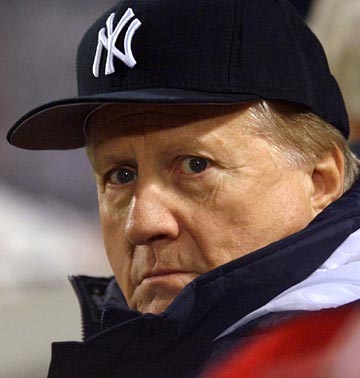
George Steinbrenner (1930-2010)


Yankees owner George Steinbrenner died on July 13. He drove some of the major changes in sports over the last four decades. He meddled with his team’s chemistry, bringing in high-priced players and calling out stars in the press. His Yankees teams won 7 titles between 1973 and 2010, which is remarkable by almost any standard except the one Steinbrenner demanded. Sports franchise owners like Mark Cuban (NBA), Dan Snyder (NFL), and Jerry Jones (NFL) are in the same mold. The following are my favorite six Steinbrenner factoids.

  1. Infamously, he fired and hired Billy Martin five times separate times.
  2. In 1990, Steinbrenner was banned “for life” from major league baseball by former Commissioner Fay Vincent. The penalty was levied because Steinbrenner had paid almost $50,000 for “dirt” on a former player. The “life” banishment lasted three years.
  3. Steinbrenner’s first franchise, the Cleveland Pipers of the American Basketball League, lasted a single season, as did the entire league.
  4. While an assistant coach under Woody Hayes at Ohio State, Steinbrenner won a national championship.
  5. After buying the Yankees franchise in 1973, for only $8.8 million, Steinbrenner instituted a policy regulating the length of player’s hair. All-Star players like Don Mattingly and David Wells have received fines or even suspensions for “hair offenses.”
  6. Actors that have played Steinbrenner include Larry David (on “Seinfeld”) and Oliver Platt (“Bronx is Burning”).

Thursday, June 24, 2010

Two Prodigies at a Crossroads

In the dog days of summer, two prodigies have arrived at a decisive moment in their careers. Stephen Strasburg debuted for the Washington Nationals, and LeBron James entered NBA free agency. Both have had an unusual role, as highly regarded first-round picks, on their teams. And, now, they might be the most important players in their respective sports in the second decade of the 21st century.

The Cleveland Cavaliers have hitched the franchise’s hopes to James, and the Washington Nationals will depend on Strasburg to overcome the youth and lack of talent around him. Each franchise has weak leadership. If James leaves Cleveland or Strasburg is a bust, either team could leave their respective cities in the next half-decade.

ESPN has made each athlete, the 22-year-old Strasburg and the 25-year old James, a news category. Watch the ticker at the bottom of the monolithic network’s broadcast to get the latest in tea leaves, innuendos, and rumors on either athlete. In fact, the 24-hour sports channel has made a cottage industry of hyping these prospects.

The Hall of Fame chatter, led by ESPN talking heads, has already started for each of them. Despite the talk, neither Strasburg nor James is the most talented prospects at their respective stages of development. They’re just the most talented in an era of media saturation and hype-as-product sensationalism.

The appeal of both athletes stems from their status as brilliant prodigies. Oddly enough, Strasburg’s debut against the last-place Pirates drew viewer interest on the same night of game three of the NBA Finals, which boasted as many as six Hall of Famers.

Even better than acknowledging when a player achieves something special is acknowledging that he could do something special, five or ten years from now. I’ve decided to reserve my astonishment for the day when commentators predict Hall of Fame greatness from sonograms or forecast future drafts based on Little League highlights.

Unfortunately, the hype seems to have been mostly destructive for James. Almost everyone agrees that he has refused to be coached by the Cavaliers staff, and the franchise’s ownership has mostly allowed James and his entourage to have their run of the facilities. Though a force of nature sprinting toward the basket, he’s content to become an average jump-shooter.

James is a highlight-reel talent and rises to almost every challenge. He’s already one of the five best players in the league and an annual MVP finalist. But even his greatest admirers have to wonder if he’ll ever be historically great, in the rarefied category of Michael Jordan, Magic Johnson, or Bill Russell. Nevertheless, I suspect that his flight in free agency probably won’t bring a title to whoever wins the sweepstakes.

James’s real long-term legacy might be in marketing, where his charisma is on full display. The basketball wunderkind took the Michael Jordan book on corporate sponsorship and added a few chapters. Jordan was basically a well-paid employee of Nike and Hanes. Unlike Jordan, James is basically an investor in the brands he endorses. And he embodies 21st century “cool” in a way that Dwayne Wade, Dwight Howard, or Kobe Bryant will never be able to.

Strasburg, on the other hand, is an unusual pheonom. That is, the marketing potential is not really there. Strasburg will get the endorsements if he performs well, but I doubt he will ever become the face of an advertising campaign or his sport.

In his first start, on June 8, Strasburg pitched seven innings and struck out 14. It’s already one of the finest outings in the Nationals brief history. The demure Californian displayed a fastball upwards of 100 mph, with great placement. He attracts attention from baseball fans and outsiders. Even if you’re not interested, you’re likely to be bombarded with his stats until you are.

But Strasburg’s arrival alone brings very little other than hope to the Nationals. Over eighty-three years ago, Washington’s greatest baseball player ever retired. Walter Johnson was a reserved, lanky, and blue-eyed right-hander, just like Strasburg, who suffered years of losing on the Nationals (in their first iteration), before winning a World Series in his 17th season. In very different eras, both Johnson and Strasburg have inspired curiosity and fear from colleagues and viewers from day one.

Will it take that many years for the contemporary pheonom’s Nationals to be within reach of a championship? Will James seriously compete for an NBA championship in Cleveland, Chicago, or Los Angeles? Most importantly, will either of them come close to fulfilling the hype that Strasburg’s debut and James’s flirtation with free agency inspired?

Taking into consideration the historical trends and my instincts, my answers would be probably, maybe, and no. But perhaps not in that order.

Tuesday, March 9, 2010

First Entry: The Great Sports Debates

I was reading an archived Slate.com review of Buzz Bissinger’s Three Nights in August. I haven’t actually gotten to Bissinger’s book, an account of a three-game series between the Cardinals and the Cubs from the eyes of manager Tony LaRussa, but the review fascinated me. The article, whose author skewered Joe Girardi, was brimming with contempt for Kissinger’s anti-Moneyball, old-school ranting. This got me thinking about some of the great ongoing sports debates. (It also doesn’t hurt that I’m still working on Bill Simmons’s tome, The Book of Basketball, which seems to have a list for every miniscule interest: Top Ten Freeloading Point Guards, Top Fifty Centers From Southern Idaho, etc. I mean that as a deep compliment, by the way.) I think I’m going to put together a list, with one entry per day of the ten greatest sports debates, and then rank them at the end. So here’s the first entry:

The Moneyball Crew vs. Traditionalists

Since Michael Lewis published Moneyball: The Art of Winning an Unfair Game in 2003, a theoretical divide has cut through most baseball fans. There’s the school of thought (that Lewis, in fact, shortchanged) that managers have a larger role in producing a winner than a general manager and that RBI, steals, and batting average are high-value stats. Lewis, and Oakland general manager Billy Beane, went on to criticize these “traditionalists” by foregrounding their subjective biases, prizing on-base percentage, and seem to minimize the importance of in-game player management. Frankly, I admire Lewis’s book, but its influence on me has less to do with my thinking on baseball and more to do with my thinking on “group think” and player evaluation. In the intervening conversations between the sides, traditionalists have pointed out Beane’s shortcomings in wins and losses, while the Moneyball crew have pointed out the success of his proteges (including Epstein of the Red Sox).

Wednesday, November 4, 2009

Should Pitchers Call Their Own Pitches?

Recently, I've been reading a lot of Malcolm Gladwell of The New Yorker. One of his books, Blink, argues that the preconscious responses of specialists can be pretty good. One marriage counselor can predict whether your marriage will work from a 5-minute conversation (to 95% accuracy), but his accuracy slides lower as he talks to the couple more. Gladwell is not arguing for the validity of rash and wild predictions but finds authority in the instincts of well-trained individuals.

Amind the Cole Hamels fiasco, I began to consider one of the strategies in baseball, with Gladwell's observations in mind. Traditionally, the pitcher (picture the grizzled veteran, played by Kevin Costner) controls the pace and structure of a game by "calling" the throws made by the pitcher (picture the impetuous youth, played by Tim Robbins). It is suggested that the catcher has a better sense of the larger chess moves in the game (base runners, placement of fielders, etc.) and a less involved perspective (the pitcher is distracted by pitch counts, the mental game with the batters, etc.). The catcher can survey the entire playing field, which is also considered an advantage. But perhaps Gladwell's observations might construe it as the opposite? Could the catcher's elevated responsibilites actually obstruct the success of the team's defense by making the game less instinctive and more cerebral?

I would welcome any feedback, examples, or anything else on this. I'm still pitching the prospective idea around.